Industrial VR: Immersive Technology Applications in Industry
How a focused VR experience at a Shell leadership event created a practical conversation about where immersive technology could support complex industrial organizations.
Introduction: Who Is This For and Why Industrial VR Matters
This content is designed for industry leaders, training managers, safety professionals, and decision-makers in sectors such as mining, energy, manufacturing, and infrastructure. Understanding industrial VR is crucial for these audiences because it offers transformative ways to train employees, improve safety, and boost productivity in complex environments. Industrial VR refers to the use of virtual reality to create immersive simulations that replicate real-world industrial scenarios, enabling safer, more effective, and repeatable training and operational planning. Virtual reality is transforming industrial sectors through immersive simulations, making it a vital tool for organizations seeking to stay competitive and safe in today’s rapidly evolving landscape.
What Is Industrial VR and Why Is It Relevant?
Industrial VR is the application of virtual reality technology to industrial environments, allowing organizations to simulate equipment, workflows, and hazardous scenarios in a safe, controlled, and repeatable manner. Virtual reality is transforming industrial sectors through immersive simulations, enabling:
Immersive Simulations: Employees can experience realistic, hands-on training without the risks associated with real-world practice.
Safety Training: VR applications include employee safety training and procedural rehearsals, enhancing safety awareness and hazard recognition.
Knowledge Retention: Immersive VR training improves knowledge retention and reduces training times by engaging users in interactive experiences.
Productivity Improvements: Facility planners and engineers can use VR to simulate factory layouts, manipulate digital twins, and identify design flaws before implementation, maximizing productivity and reducing costs.
Main Benefits and Use Cases of Industrial VR
Industrial VR offers a range of benefits and use cases, including:
Immersive Simulations: Virtual reality is transforming industrial sectors through immersive simulations, allowing employees to practice complex tasks in a risk-free environment.
Safety Training: VR enhances safety training in industrial environments by simulating hazardous situations for training purposes, reducing the risk of accidents in heavy industries.
Knowledge Retention: VR training improves knowledge retention during training sessions and can reduce training times significantly by creating immersive experiences.
Repeatable, Safe Training: VR enables safer, repeatable training with less equipment use, promoting hazard recognition and safety awareness.
Standardized Protocols: Standardized training in VR reduces regional variations in safety protocols and simulates high-consequence, low-frequency events for training safety.
Maintenance and Emergency Response: Technicians rehearse complex maintenance procedures in VR to minimize errors, and VR training is beneficial for practicing complex emergency responses.
Productivity and Planning: VR allows facility planners to simulate factory layouts to maximize productivity, and engineers can manipulate 1:1 scale digital twins to identify design flaws.
Immersive Technology and Industrial Applications: Setting the Context
Immersive technology, particularly industrial VR, is revolutionizing how industrial organizations approach training, safety, and operational planning. By leveraging virtual reality, companies can create interactive, spatial environments that help people understand information in context. This technology is not just about wearing a headset—it’s about building environments that support:
Training and simulation of equipment and workflows
Safety and scenario training for hazardous or rare events
Visualization of operations and facilities
Remote collaboration and site experiences
Digital twins for design and planning
Virtual reality is transforming industrial sectors through immersive simulations, making it possible to address challenges that traditional training and communication methods cannot fully solve.
A Simple Augmented Reality Experience, Built for a Leadership Audience
Immersive technology does not always need a long explanation. Sometimes the most useful way to understand its potential is simply to experience it.
That was the thinking behind the experience iMakerXR developed for a Shell leadership event in Vancouver. We created an immersive open-pit haul truck driving simulation that allowed participants to step into the driver’s position, use familiar physical controls and navigate a virtual industrial environment.
The objective was straightforward: give a leadership audience a clear, hands-on reference point for understanding what an immersive experience can do and where similar approaches might be useful across a complex organization.
From a Virtual Reality Demo to Better Industrial Questions
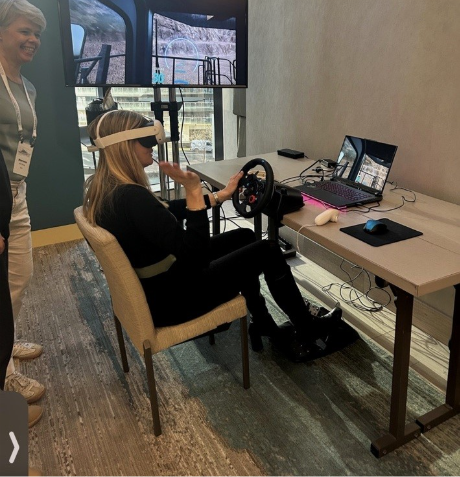
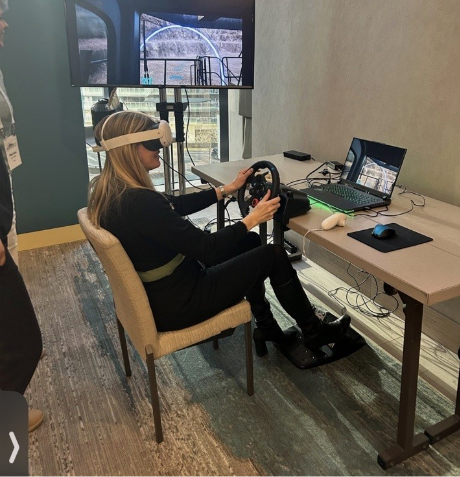
The experience was designed to move quickly from explanation to interaction. The participant wore the headset, used a steering wheel and pedal set, and operated the haul truck within the virtual environment. A large external display mirrored the participant’s view so colleagues could follow the experience at the same time.
That combination mattered because it shifted the conversation. Instead of spending time explaining the mechanics of VR, the experience gave participants something concrete to react to. The questions became more practical: Where else could this be useful? What would this look like with our own equipment or site? Could an immersive environment help communicate a scenario that is difficult to recreate physically?
The response was strong. iMakerXR received highly positive feedback from Shell executive leaders on the quality of the work, and the experience created a useful reference point for discussing immersive technology beyond a single haul-truck simulation.
Participants experienced the simulation through the headset while using physical steering and pedal controls.
This demonstration highlights broader opportunities for immersive technology in industry, which we explore next.
The Bigger Opportunity for Immersive Technologies Is Beyond the Headset
Immersive technology, and specifically industrial VR, refers to the use of virtual reality to create interactive, spatial environments that help people understand information in context. Virtual reality is transforming industrial sectors through immersive simulations, enabling organizations to address complex challenges in training, safety, and operations.
Training & Simulation
Training & Simulation: Recreate equipment, workflows, and operating scenarios in repeatable virtual environments that support worker training. This includes emergency drills that build response muscle memory and reduce the risk of accidents in heavy industries.
Safety & Scenario Training
Safety & Scenario Training: Allow teams to rehearse situations in a controlled environment before encountering them in the field, improving safety readiness through realistic practice. VR can simulate hazardous situations for training purposes and is beneficial for practicing complex emergency responses.
Equipment Simulation
Equipment Simulation: Create interactive experiences around vehicles and equipment without requiring continuous access to physical assets. Technicians can rehearse complex maintenance procedures in VR to minimize errors.
Operational Visualization
Operational Visualization: Turn facilities, processes, and industrial environments into intuitive 3D experiences. Augmented reality (AR) supports worker training and real-time data visualization in the field.
Digital Twins & Reusable 3D Environments
Digital Twins & Reusable 3D Environments: Build visual environments for planning, communication, operations, and future content expansion. Engineers can manipulate digital twins to identify design flaws early and facility planners can simulate factory layouts to maximize productivity.
Remote Site Experiences
Remote Site Experiences: Bring hard-to-access sites and environments to distributed teams, partners, and stakeholders, including shared virtual spaces where teams can inspect components together.
AI is also strengthening AR/VR workflows for industrial maintenance, training, and operational support, with ongoing innovations expanding what these systems can do, especially when paired with technical 3D animation for complex industrial procedures.
AR-based guidance in manufacturing can enhance maintenance procedures and reduce downtime, while technicians can rehearse complex equipment repairs before doing the work.
The same thinking also applies to leadership communication, stakeholder engagement, design reviews, and project storytelling when a traditional slide or video cannot fully communicate spatial context or interaction. It extends to product design through virtual prototypes that reduce material waste and costs, as well as facility planning through layout simulations that maximize productivity before investment.
This broad range of applications demonstrates how industrial VR and immersive technology are reshaping the way organizations approach training, safety, and operational efficiency.
Why This Matters for Industrial Automation and Complex Industries
Communication Challenges
Mining, energy, infrastructure, manufacturing, and industrial technology share a communication challenge:
Much of the work is complex, spatial, and difficult to experience firsthand.
Sites can be remote.
Equipment can be expensive or unavailable.
Operating scenarios can be unsafe to reproduce.
Future facilities may not exist yet.
Technical information can be difficult for non-specialists to interpret.
Traditional media will always play an important role:
Drawings, presentations, animation, and video communicate enormous amounts of information efficiently.
Immersive technology adds another layer when spatial understanding, interaction, or experience matters.
Designing Effective Immersive Projects
The strongest immersive projects are therefore not built around VR for the sake of VR. They start with the communication or operational challenge:
What does the audience need to understand?
What should they be able to do?
Which parts of the environment need to be interactive?
What information should be visible before, during, and after the experience?
What would make the scenario more intuitive than a conventional presentation?
When those questions drive the design, immersive technology becomes a practical tool rather than a novelty. They also clarify the next steps for the audience after the experience. It can shorten the distance between technical information and human understanding.
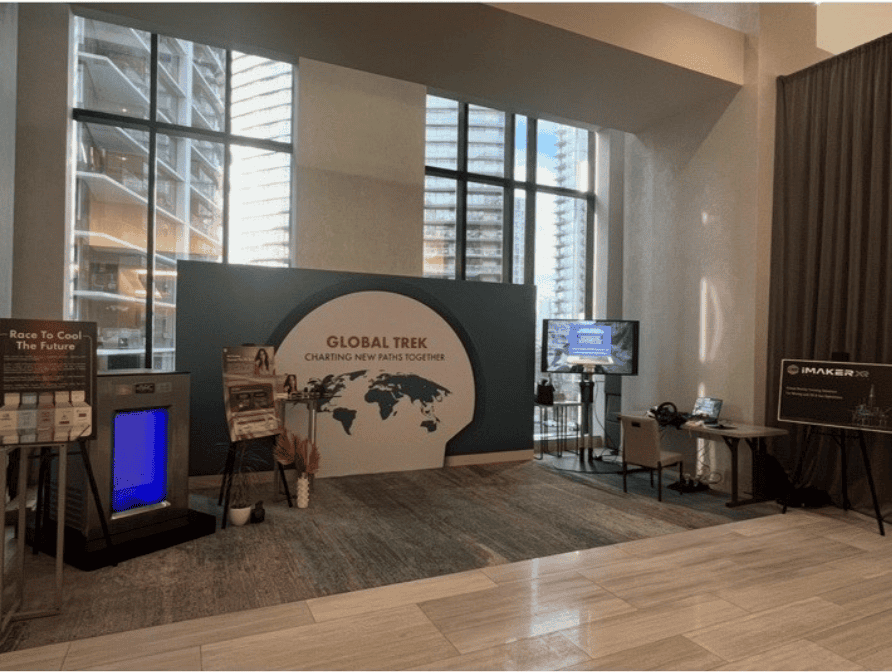
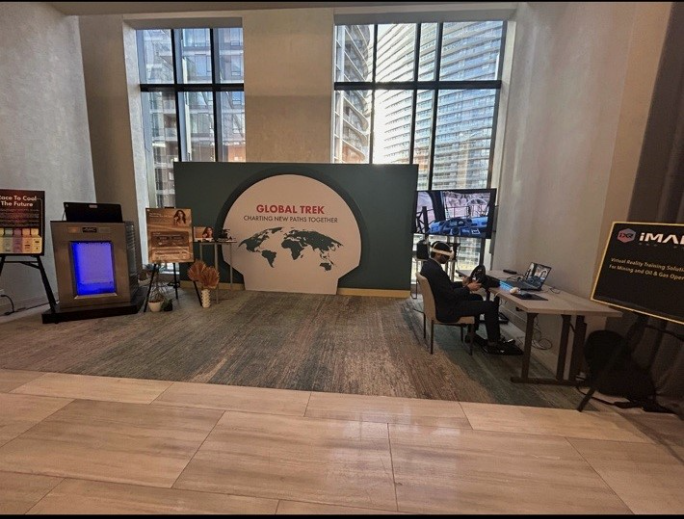
The iMakerXR VR experience within Shell’s Global Trek event environment in Vancouver.
What could your team understand faster if they could experience it instead of only seeing it on a slide?
You’re under pressure to keep crews safe while equipment uptime can’t slip. With industrial augmented reality, you can place hazard zones, lockout steps, and tool guidance directly in a technician’s…
You’re seeing virtual reality and digital twins move from optional tools to operational essentials. You can train crews in realistic scenarios, test procedures without shutdowns, and mirror critical assets with…